



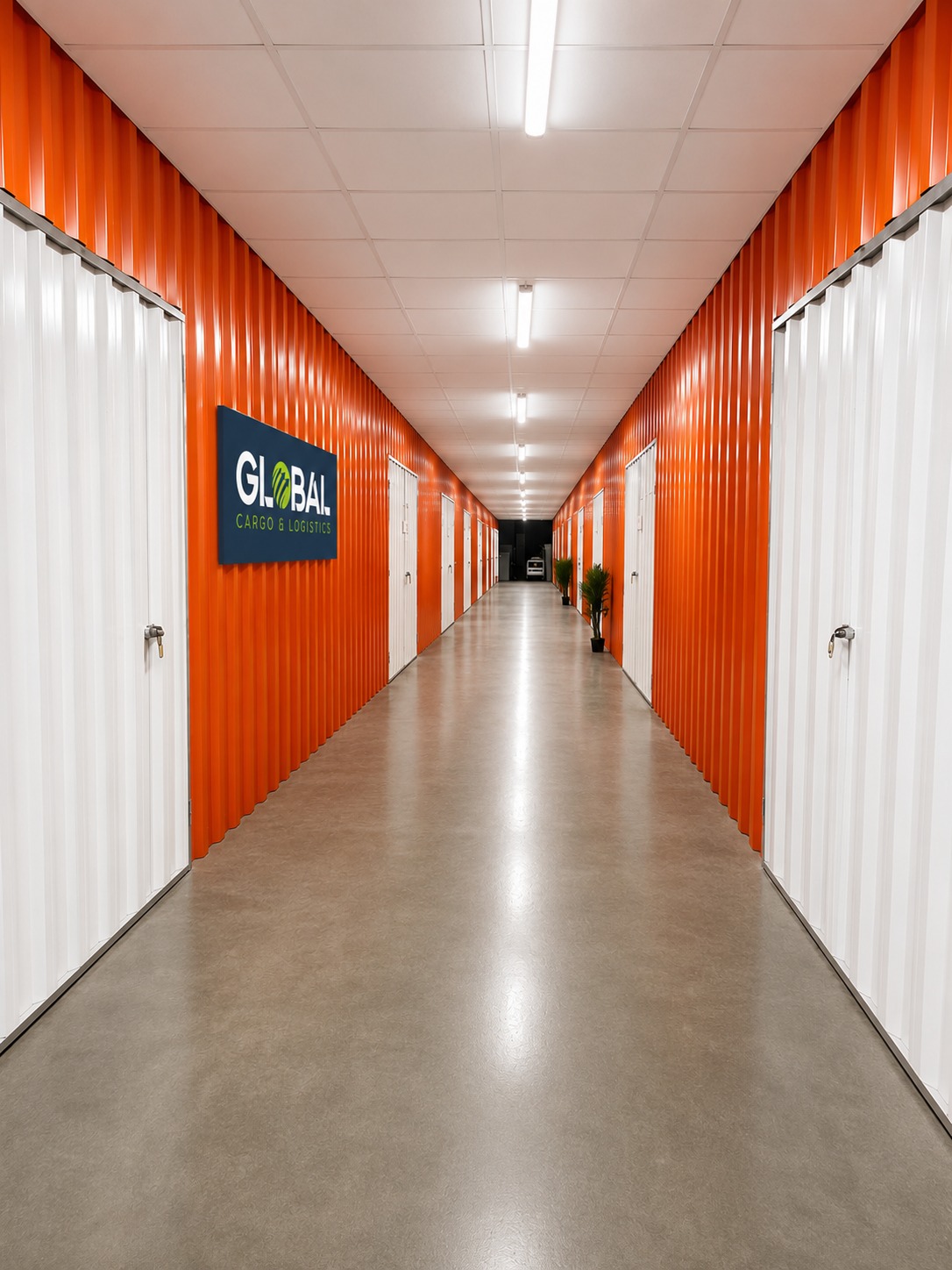
Warehouse vs Self Storage in Abu Dhabi: Which One Is Right for You?
Choosing between Warehouse vs self storage is not always as straightforward as it sounds.
Both options give you extra space, but they are designed for very different needs.
A warehouse may be the right choice for a business handling large quantities of stock, frequent loading activity, pallets, or distribution operations. Self storage, on the other hand, is often better suited to individuals, small businesses, families, expats, and companies that simply need a secure private space without taking on a large commercial property.
At Global Cargo, we help customers understand the difference so they can choose the option that actually matches their needs.
If you only need extra room for furniture, documents, business inventory, personal belongings, office equipment, or seasonal stock, renting a full warehouse may be more than you need.
That is where the comparison between Warehouse vs self storage becomes important.
The Main Difference Between Warehouse and Self Storage
The simplest difference is scale and purpose.
A warehouse is generally designed for larger commercial operations. It may be used for bulk inventory, pallet storage, distribution, loading and unloading, or supply-chain activity.
Self storage is usually more flexible.
You rent a dedicated unit based on the amount of space you actually need, and your belongings stay within your own defined area.
When comparing Warehouse vs self storage, think about whether you need a large operational facility or simply additional secure space.
If your requirement is mainly storage rather than logistics, self storage can often be the simpler option.
When a Warehouse Makes Sense
Warehouses are useful for businesses with substantial storage requirements.
A company may need warehouse space if it is receiving large shipments, handling pallets, operating forklifts, managing bulk inventory, or distributing products to customers.
Warehouses can also make sense for companies that need:
- Large-volume stock handling
- Frequent truck access
- Pallet racking
- Dispatch operations
- Packing and fulfilment areas
- Loading bays
- Large teams working on-site
- Industrial equipment
- High daily movement of goods
In these cases, a warehouse is not simply a place to store things.
It becomes part of the company’s daily operations.
That is a major difference when considering Warehouse vs self storage.
When Self Storage Makes More Sense
Self storage is often better when you need space without the complexity of running a warehouse.
You may only need somewhere for:
- Business stock
- Office furniture
- Documents
- Household furniture
- Boxes
- Electronics
- Seasonal items
- Marketing materials
- Equipment
- Personal belongings
With self storage, you can choose a unit based on your actual volume.
That means you are not taking on an entire commercial warehouse when you may only need 50, 100, or 200 SQFT.
For many customers comparing Warehouse vs self storage, this flexibility is one of the biggest advantages of self storage.
Cost Is Often the Biggest Difference
Cost plays a major role in the decision.
A warehouse may involve more than monthly rent.
Depending on the property, there may also be costs linked to utilities, fit-out, maintenance, staffing, security, equipment, insurance, and longer lease commitments.
Self storage is generally more straightforward.
You rent the space you need and avoid taking on many of the operational responsibilities associated with a larger warehouse.
This makes the Warehouse vs self storage comparison especially important for small businesses.
If your company only needs extra space for inventory or records, paying for an entire warehouse may not be the most efficient use of money.
Self Storage Can Be Easier to Scale
Business storage needs can change quickly.
You may have more inventory during a busy season and less during quieter months.
You may be moving office.
You may be launching a new product.
Or you may simply need temporary overflow space.
Self storage makes it easier to match your space to your current needs.
Instead of committing to a large fixed property, you can choose a unit that suits the volume you actually have.
This makes Warehouse vs self storage an important consideration for companies that want flexibility.
A growing business can use self storage before it reaches the point where a dedicated warehouse becomes necessary.
Privacy and Dedicated Space
Another important difference is how belongings are stored.
At Global Cargo, customers receive a dedicated secure storage unit.
Your belongings remain within your own defined unit rather than being spread across a shared warehouse floor.
This can make self storage easier to organise.
You know exactly where your stock, furniture, documents, or equipment is located.
For customers comparing Warehouse vs self storage, a dedicated private unit can be particularly useful when belongings do not require a full warehouse operation.
Access Requirements Matter
Ask yourself how often you need to access your stored items.
A warehouse may be appropriate if staff are working on-site every day, receiving deliveries, picking stock, and dispatching orders.
Self storage is different.
It is ideal when you need convenient access but do not need a full-time operational facility.
Global Cargo provides 24/7 access, allowing customers to reach their storage units when required.
This makes self storage useful for both individuals and businesses with flexible schedules.
When evaluating Warehouse vs self storage, access should be considered alongside the amount of space you need.
Climate-Controlled Storage
The storage environment also matters.
Abu Dhabi experiences high temperatures for much of the year, which can make indoor storage conditions especially important for furniture, electronics, documents, packaging, and other suitable items.
Global Cargo provides climate-controlled storage, helping maintain a more stable indoor environment.
Not every warehouse is climate controlled.
Some warehouse facilities are designed primarily for industrial or bulk goods where environmental stability is less important.
This is another factor to consider when comparing Warehouse vs self storage.
If you are storing belongings that benefit from a more controlled indoor setting, self storage may be the more suitable choice.
Security Differences
Warehouses and self-storage facilities can both offer security, but the setup may be different.
A large warehouse may have open operational areas where staff, deliveries, equipment, and goods move throughout the day.
Self storage is generally focused more heavily on individual customer units.
At Global Cargo, customers benefit from dedicated secure units and CCTV surveillance.
This means your storage is separated from other customers’ belongings.
For someone comparing Warehouse vs self storage, this can provide a simpler and more private arrangement.
Warehouse Space Can Be Too Much for Small Businesses
Many businesses assume they need a warehouse simply because they have run out of office space.
That is not always true.
If your office is filling with cartons, documents, spare furniture, seasonal stock, or packaging materials, a warehouse may be excessive.
Self storage can solve the same space problem on a smaller scale.
For example, a company may only need 75 or 100 SQFT of additional space.
Renting a much larger warehouse for that requirement may not make financial sense.
That is why Warehouse vs self storage should be considered based on actual storage volume, not simply the fact that your business needs more room.
Self Storage for Retailers
Retailers often experience changing stock levels.
Before a promotion, holiday period, or busy season, inventory can increase significantly.
A shop’s backroom may not have enough capacity.
Self storage can give retailers overflow space without requiring a permanent warehouse.
Products, displays, packaging materials, and seasonal stock can be moved into a dedicated unit.
For smaller retailers, the Warehouse vs self storage decision may come down to whether they need full-scale logistics or simply extra room.
If the requirement is mainly overflow stock, self storage may be more practical.
Self Storage for E-Commerce Businesses
E-commerce companies can grow quickly.
A business may start from a home office and suddenly find itself surrounded by products, cartons, and packaging supplies.
Moving directly into a warehouse may be a big financial step.
Self storage can provide an intermediate solution.
Inventory can be stored away from the home while remaining accessible when needed.
This makes Warehouse vs self storage particularly relevant for online sellers who are growing but not yet ready for a dedicated warehouse.
Self Storage for Documents and Archives
Warehouses are not always ideal for archived paperwork.
Business records, contracts, invoices, reports, and other documents often need a clean, organised, and controlled environment rather than a large industrial space.
Self storage can be more suitable for these requirements.
Documents can be organised inside clearly labelled cartons, shelves, or filing cabinets within a dedicated unit.
The climate-controlled environment at Global Cargo can also be useful for paper records.
When comparing Warehouse vs self storage for documents, the smaller and more controlled environment of self storage can be an advantage.
Self Storage for Office Furniture
Companies often need temporary space for office furniture.
This may happen during relocation, renovation, downsizing, or office redesign.
Desks, chairs, cabinets, shelving, and meeting tables can take up a lot of room.
Renting warehouse space just for temporary furniture may be unnecessary.
Self storage allows companies to choose a unit based on the amount of furniture being stored.
This is a good example of where Warehouse vs self storage becomes a practical cost decision.
Household Storage Is Usually Better Suited to Self Storage
For personal belongings, self storage is normally much more suitable than a warehouse.
People may need storage while:
- Moving house
- Renovating
- Travelling
- Relocating
- Downsizing
- Waiting for a property
- Leaving the UAE temporarily
In these situations, belongings such as furniture, boxes, appliances, luggage, clothing, and personal items do not require a commercial warehouse.
A dedicated self-storage unit is usually more convenient and easier to manage.
For household customers, the Warehouse vs self storage decision is generally much simpler.
Self storage is designed around this type of requirement.
Unit Size Flexibility
One of the strongest advantages of self storage is the range of possible unit sizes.
You may only need a small amount of space.
For example:
10–25 SQFT can suit boxes, documents, luggage, or small business items.
25–50 SQFT can work for larger collections of boxes, office supplies, or small furniture.
75–100 SQFT may suit apartment contents, furniture, or business inventory.
150–250 SQFT or more can accommodate larger household or commercial requirements.
A warehouse usually starts at a much larger scale.
That is why the Warehouse vs self storage comparison often comes down to whether your requirement is measured in individual units or full commercial premises.
Warehouses Require More Management
A warehouse can become another operation that your business has to manage.
You may need to think about access control, staff, cleaning, equipment, utilities, maintenance, shelving, safety, and daily operations.
Self storage is simpler.
The facility is already managed.
You focus on organising your own unit and belongings.
For businesses that do not need active warehouse operations, this can reduce unnecessary complexity.
The Warehouse vs self storage choice is therefore not only about space.
It is also about how much responsibility you want to take on.
Self Storage Can Be Better for Short-Term Needs
Sometimes you only need extra space for a few weeks or months.
A warehouse may involve longer commitments than your situation requires.
Self storage can be more suitable for temporary needs such as:
- Renovation
- Office moves
- Seasonal stock
- Temporary relocation
- Event equipment
- Excess inventory
- Property handovers
This makes self storage attractive when you do not want to commit to a large long-term commercial property.
For short-term requirements, Warehouse vs self storage often favours self storage because of its flexibility.
Warehouses Are Better for High Daily Activity
Self storage is not always the best solution.
If your business is receiving large trucks daily, operating forklifts, processing hundreds of orders, or constantly moving pallets, a warehouse may be necessary.
A full warehouse gives you more operational freedom for high-volume logistics.
This is why the Warehouse vs self storage decision should be based on what happens inside the space.
If the space is mainly for keeping items, self storage may be enough.
If the space is part of a full logistics operation, a warehouse may be more appropriate.
Consider How Much Staff Will Use the Space
Another factor is staffing.
A warehouse may have multiple employees working inside every day.
Self storage is generally not intended to function as a full workplace.
It is a place to securely store and retrieve belongings.
If you need teams packing orders, processing shipments, or working continuously from the facility, warehouse space may be more suitable.
If you only need occasional access to stored belongings, self storage is likely the better option.
This distinction helps make the Warehouse vs self storage decision clearer.
Consider Your Lease Commitment
Commercial warehouse leases can involve larger financial commitments.
Businesses may need to sign longer contracts and accept fixed space even when storage requirements change.
Self storage gives customers more flexibility.
You can choose the space you need based on current requirements.
For businesses that are growing, changing location, or testing new markets, this can be valuable.
The Warehouse vs self storage decision should therefore consider how certain you are about your future storage needs.

Self Storage Can Help Delay Expensive Expansion
A growing company may eventually need a warehouse.
But it may not need one today.
Self storage can help bridge the gap.
Instead of immediately moving into larger premises, the company can move overflow stock, archived documents, furniture, or equipment into storage.
This frees up space in the current office or shop.
As the business grows, management can then decide when a warehouse becomes financially and operationally necessary.
For many small companies, Warehouse vs self storage is not an either-or decision forever.
Self storage can simply be the right step before warehouse expansion.
Long-Term Storage Costs Can Still Be Attractive
Self storage can also work for longer periods.
At Global Cargo, customers who choose longer storage plans can benefit from additional value.
Customers selecting a six-month plan receive discounted pricing, while annual customers can receive one month of storage free.
This can make self storage more attractive for businesses or individuals who know they will need extra space for an extended period.
When comparing Warehouse vs self storage, long-term pricing should be considered alongside the additional expenses that may come with running a warehouse.
Storage Conditions Should Match the Items
Not all belongings need the same environment.
Industrial materials may be perfectly suitable for standard warehouse conditions.
Furniture, documents, electronics, business records, packaging, and personal belongings may benefit more from a clean, climate-controlled environment.
Global Cargo focuses on self storage that is clean, secure, climate controlled, and well maintained.
This makes it particularly suitable for belongings where condition matters over time.
In the Warehouse vs self storage comparison, the type of items being stored should be one of the first questions you ask.
Self Storage for Start-Ups
Start-ups often need to control costs carefully.
A warehouse may create unnecessary overhead before the company reaches the scale to justify it.
Self storage can give a start-up room for stock, files, office furniture, promotional items, or equipment without committing to a larger commercial property.
This gives the business time to grow naturally.
For start-ups comparing Warehouse vs self storage, the smaller commitment of self storage can often make more sense.
Self Storage for Contractors and Service Businesses
Contractors and service companies may need somewhere to keep equipment, supplies, signage, spare materials, or work-related items.
If these belongings do not require a full industrial operation, self storage can provide a convenient alternative.
A dedicated unit keeps business items organised without allowing them to fill vehicles, offices, or homes.
Again, the Warehouse vs self storage decision depends on whether you need operational warehouse space or simply a secure storage location.
Self Storage for Expats
Expats may need storage while travelling, changing jobs, moving properties, or leaving the UAE temporarily.
A warehouse would usually be unnecessary for personal belongings.
Self storage is more appropriate because it allows customers to rent a unit that matches the volume of their furniture and boxes.
With 24/7 access and climate-controlled units, Global Cargo provides a practical option for expats who need flexibility.
This is another clear example of how Warehouse vs self storage depends heavily on the customer type.
Which One Gives You Better Control?
Control means different things in different situations.
A warehouse gives a business operational control over a large commercial space.
Self storage gives the customer control over a smaller dedicated unit without requiring them to manage the entire facility.
For many individuals and small businesses, that second type of control is more useful.
You can access your unit when needed, organise it your way, and keep belongings separate.
In the Warehouse vs self storage comparison, the best choice is the one that gives you the level of control you actually need.
Which Option Is Easier to Maintain?
A warehouse can require significant maintenance.
Cleaning, repairs, utilities, pest control, safety arrangements, and facility management may all need to be handled.
In self storage, the facility operator manages the wider property.
At Global Cargo, our storage areas are kept clean, organised, and well maintained.
This means customers can focus on their own belongings rather than worrying about managing the entire building.
For people looking for simplicity, this is another advantage in the Warehouse vs self storage comparison.
Security and CCTV
Global Cargo provides CCTV surveillance across the facility and dedicated secure units for customers.
This gives customers a defined private space within the storage property.
Warehouses may also use CCTV, but the environment can involve more daily activity, staff, vehicles, and shared operational areas.
For belongings that do not need constant movement, self storage can provide a quieter and more controlled environment.
Security should always be considered when comparing Warehouse vs self storage.
Fire Safety
Safety measures are also important.
Global Cargo has fire extinguishers available on-site as part of our facility safety arrangements.
Customers storing furniture, business stock, documents, or personal belongings should always consider how professionally the facility is managed.
When choosing between Warehouse vs self storage, do not focus only on size.
Look at access, security, climate control, maintenance, cleanliness, and overall facility management.
A Simple Way to Decide
If you are still unsure, ask yourself these questions:
Do you need staff working inside the space every day?
Do you need forklifts or pallet handling?
Do you receive large commercial shipments regularly?
Do you need loading bays?
Do you require full distribution operations?
If the answer to most of these questions is yes, a warehouse may be the better choice.
If your main requirement is secure extra space for inventory, furniture, documents, equipment, or personal belongings, self storage may be the more practical option.
That is the simplest way to approach Warehouse vs self storage.

Why Choose Global Cargo Self Storage?
At Global Cargo, our storage facility is designed for customers who want secure, convenient extra space without the complexity of managing a full warehouse.
Customers benefit from 24/7 access, allowing belongings to be reached whenever necessary.
Our units are climate controlled, helping provide a more suitable environment for furniture, documents, electronics, business stock, and household belongings.
Each customer receives a dedicated secure storage unit, while the facility is supported by CCTV surveillance.
Fire extinguishers are available on-site, and the facility is kept clean, organised, and well maintained.
We also aim to make the entire experience easy and smooth, from choosing the right storage size to moving belongings in and accessing them later.
For many people comparing Warehouse vs self storage, Global Cargo provides the flexibility of extra space without the burden of taking on an entire warehouse.

Frequently Asked Questions
What is the main difference between Warehouse vs self storage?
A warehouse is generally designed for larger commercial operations, while self storage provides smaller dedicated units for individuals and businesses that mainly need secure extra space.
Is self storage suitable for business inventory?
Yes. Suitable business inventory, stock, documents, furniture, equipment, and other approved commercial items can be stored in self-storage units.
Is a warehouse cheaper than self storage?
It depends on the amount of space and type of operation required. A warehouse may be more efficient for very large volumes, while self storage can be more cost-effective for smaller or flexible requirements.
Can I access a self-storage unit whenever I need something?
Global Cargo provides 24/7 access, giving customers greater flexibility to reach their units.
Is self storage climate controlled?
At Global Cargo, yes. Climate-controlled storage helps provide a more stable indoor environment for suitable belongings.
What size self-storage unit do I need?
The right size depends on what you plan to store. Smaller units may suit boxes and documents, while larger units can accommodate furniture, business inventory, or household contents.
Is self storage suitable for long-term use?
Yes. Self storage can be used for both short and long periods, including discounted longer-term storage plans.
Warehouse vs Self Storage: Make the Choice Based on What You Actually Need
The right storage solution is not necessarily the largest one.
It is the one that gives you the right amount of space, the right level of access, and the right environment without unnecessary cost or complexity.
A warehouse is an excellent solution when a business needs large-scale storage and active logistics operations.
Self storage is often better when the requirement is simpler: somewhere secure for inventory, furniture, documents, equipment, or personal belongings.
When comparing Warehouse vs self storage, think about your actual volume, how frequently you need access, whether you require staff working on-site, and how much flexibility you want.
If you simply need additional space without taking on a large commercial property, Global Cargo self storage in Abu Dhabi may be the more practical choice.
Call or WhatsApp: +971 58 105 2006
Email: info@globalcargoandlogistics.com
Website: www.globalcargoandlogistics.com